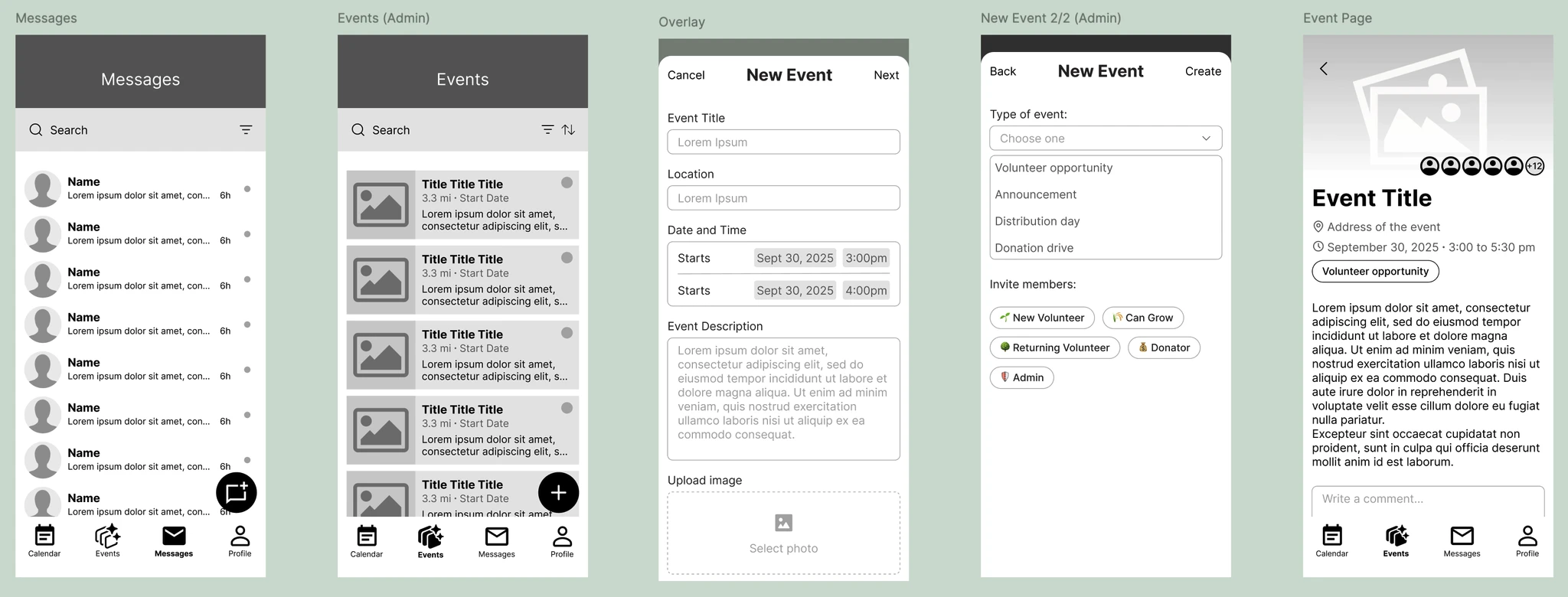

Overview
I first got to know Benjamin Taylor, the founder of Free2Tree, during an interview where I asked to learn more about his mutual aid program to address food security and environmental resilience in his community.
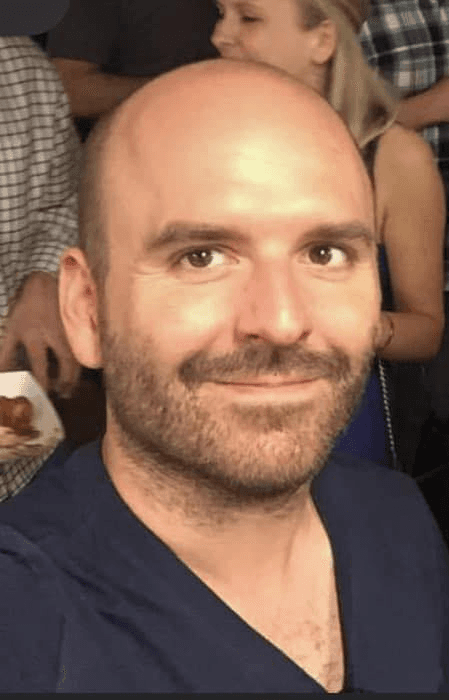
Benjamin grew up in New Orleans, a city in Louisiana that has been deeply impacted by repeated hurricane disasters. He spoke about seeing the impact Hurricane Katrina had on his environment, destroying thousands of trees and leaving countless communities in desperate need for food and supplies. Witnessing the impact of food banks and mutual aid efforts on people’s livelihoods had motivated him to create his own non-profit program to plant and distribute fruit trees as a long-term, sustainable solution.
The Challenge:
As the sole coordinator of Free2Tree, Benjamin currently manages outreach, volunteer communication, and event coordination largely on his own, relying heavily on social media and manual tracking. While he’s deeply motivated by his mission, he expressed that keeping volunteers informed, engaged, and organized has become increasingly time-consuming and difficult to scale. With Free2Tree expanding to include more members beyond his network on Instagram, Benjamin is looking for ways to make coordination easier and reduce the day-to-day burden of running the program on his own.
Research
Interview Findings:
In a follow-up interview with Benjamin, I asked him targeted questions to build a clear picture of what his organization is involved in, the current struggles he’s facing, what organization methods he’s currently using, and the specific needs he would look for in an ideal solution.
Benjamin described the current state of Free2Tree as a volunteer group of 15-20 regular members that meets periodically to prepare land for planting, assist in distributing produce trees to people in need, and run donation campaigns for machinery and large-scale projects.
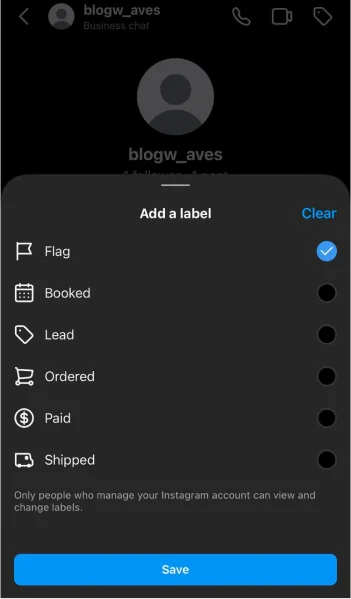
He uses Instagram’s list function to categorize his followers into the following categories:
Flagged - DMs from these members are pinned at the top of list (ex. Unique events that can’t be easily categorized)
Booked - Willing to grow trees on their land
Lead - Offered to volunteer in work efforts
Shipped - Already volunteered at least once
Paid - Offering to donate for the cause
Though this method has been acceptable thus far, Benjamin finds it frustrating that Instagram’s default labels can’t be edited and thus aren’t reflective of the people they’re marking. In addition, he often reaches out to similar groups on Facebook and Signal (messaging app) for additional volunteers and assistance. These outside members don’t always have Instagram and would rarely ever set up an account for the sole purpose of following a volunteer page, so in the end Benjamin finds himself split between all sorts of communication platforms.
By the end, I was able to identify his main goals and frustrations:
Goals:
Keep volunteers updated in a timely and non-intrusive manner
Differentiate the different types of volunteers that can help his cause
Propagate and grow as many trees as possible through growing his volunteer group and communicating with other similar organizations
Educate people on managing food security using produce trees
Frustrations:
Instagram’s labels aren’t reflective of the people they’re marking
Contacting volunteers one by one through DMs is too time-consuming
Concerned about overwhelming casual volunteers
Problem Statement:
“Benjamin needs a better way to connect with new volunteers and manage his current ones, because social media doesn’t cover everyone who might be interested as the project continues to scale up.”
Design Process
Overall, the lack of centralization revealed the need for a centralized platform that could meet the needs of the organizer, and be convenient to the volunteers in a way that neither overwhelms or underwhelms them.
My goal was to create an interface for a mobile platform that could meet the needs of Free2Tree from its volunteers to its coordinators.
Task Flow:
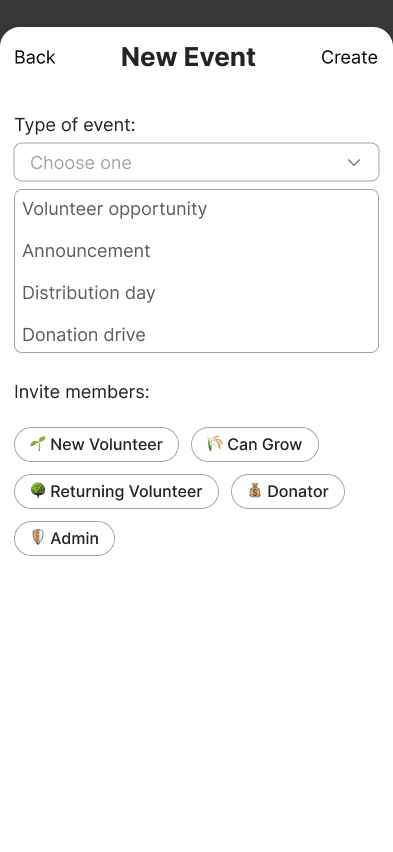
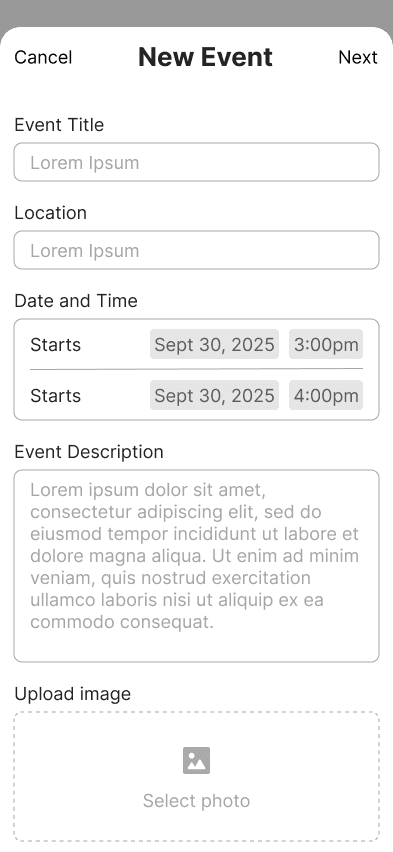
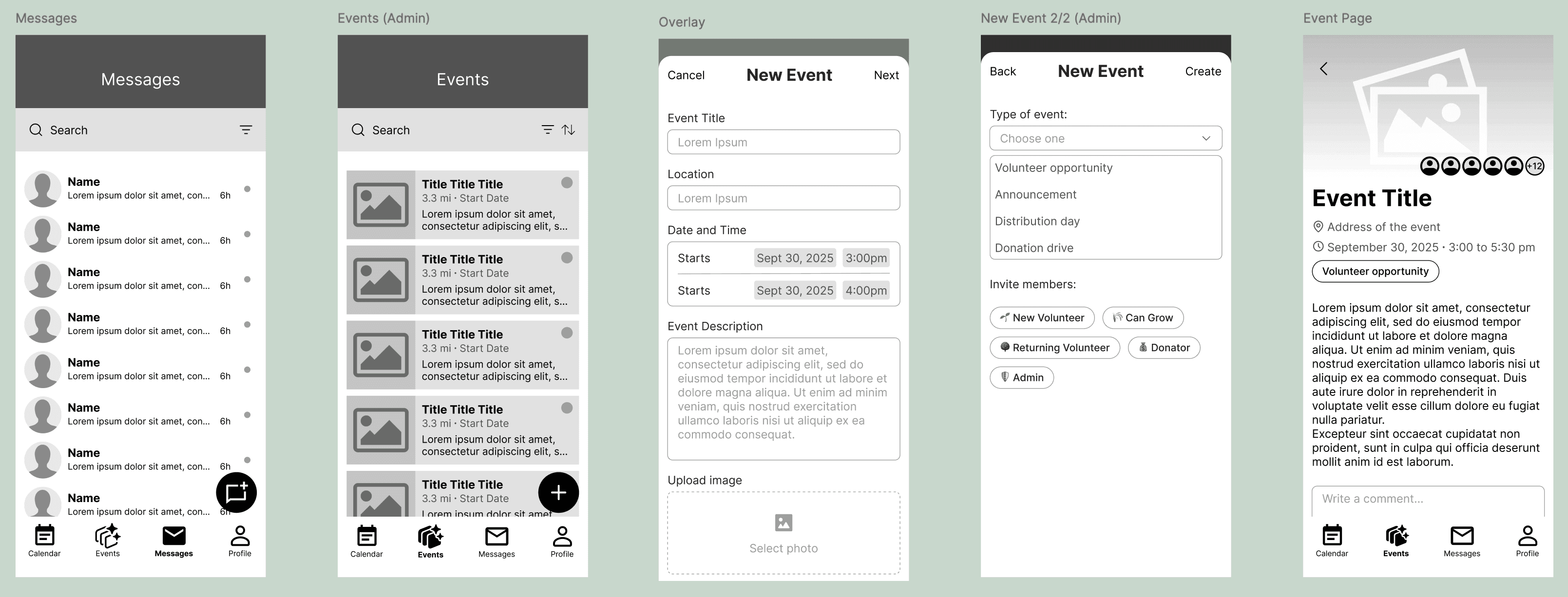
My first objective was to create a flow that defined how a user might take steps to navigate this app and complete a task. Since my client was the main coordinator of the organization, I made the task flow from the perspective of an admin user who wants to create an event directed towards certain volunteer members:
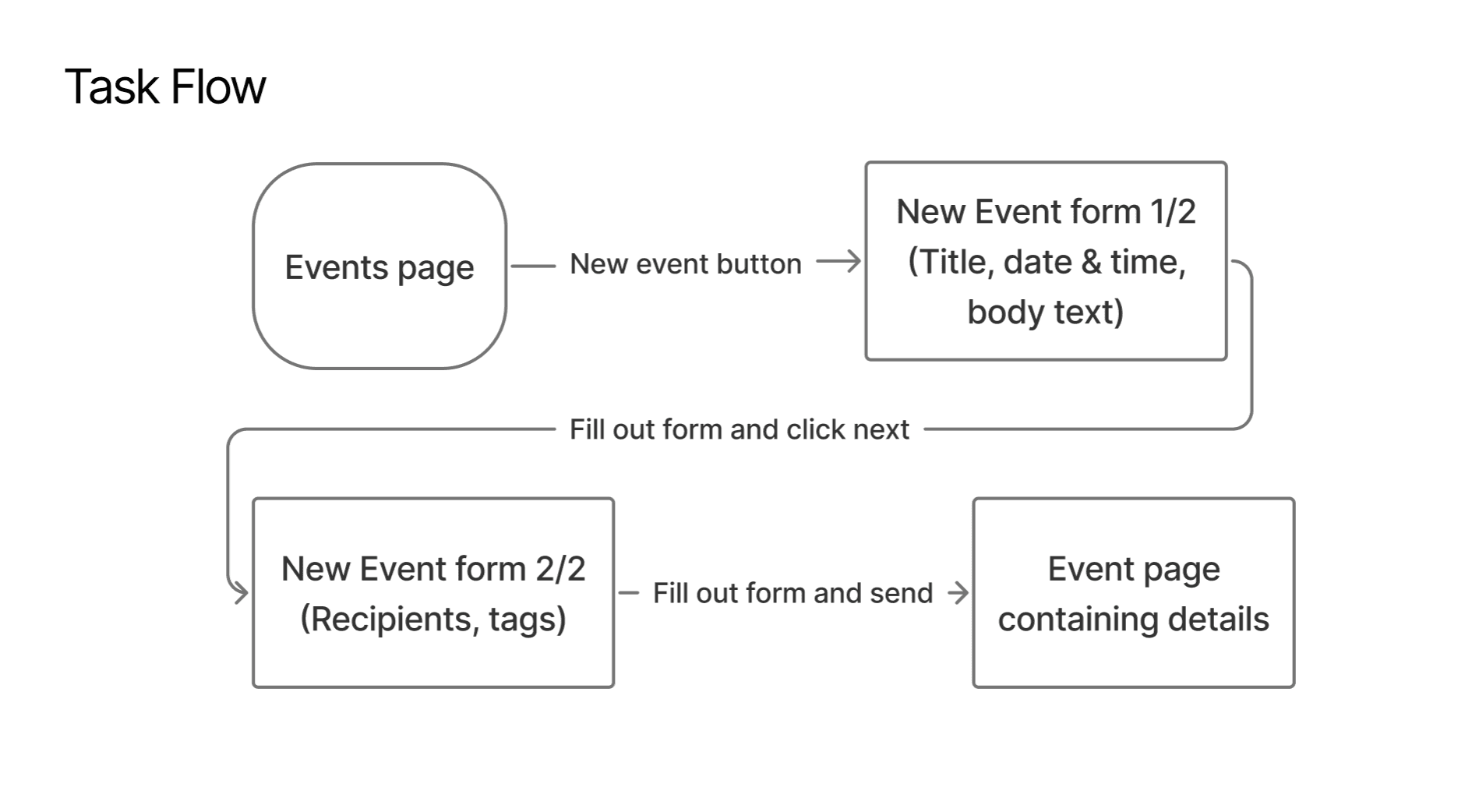
This act allows Benjamin to openly communicate with the volunteers he intends on contacting for their related cause–for instance, notifying all potential donors of an upcoming campaign to purchase a new field tiller. He no longer needs to direct message each donor manually, though having the DM feature to contact specific members is still useful to have.
Sketches:
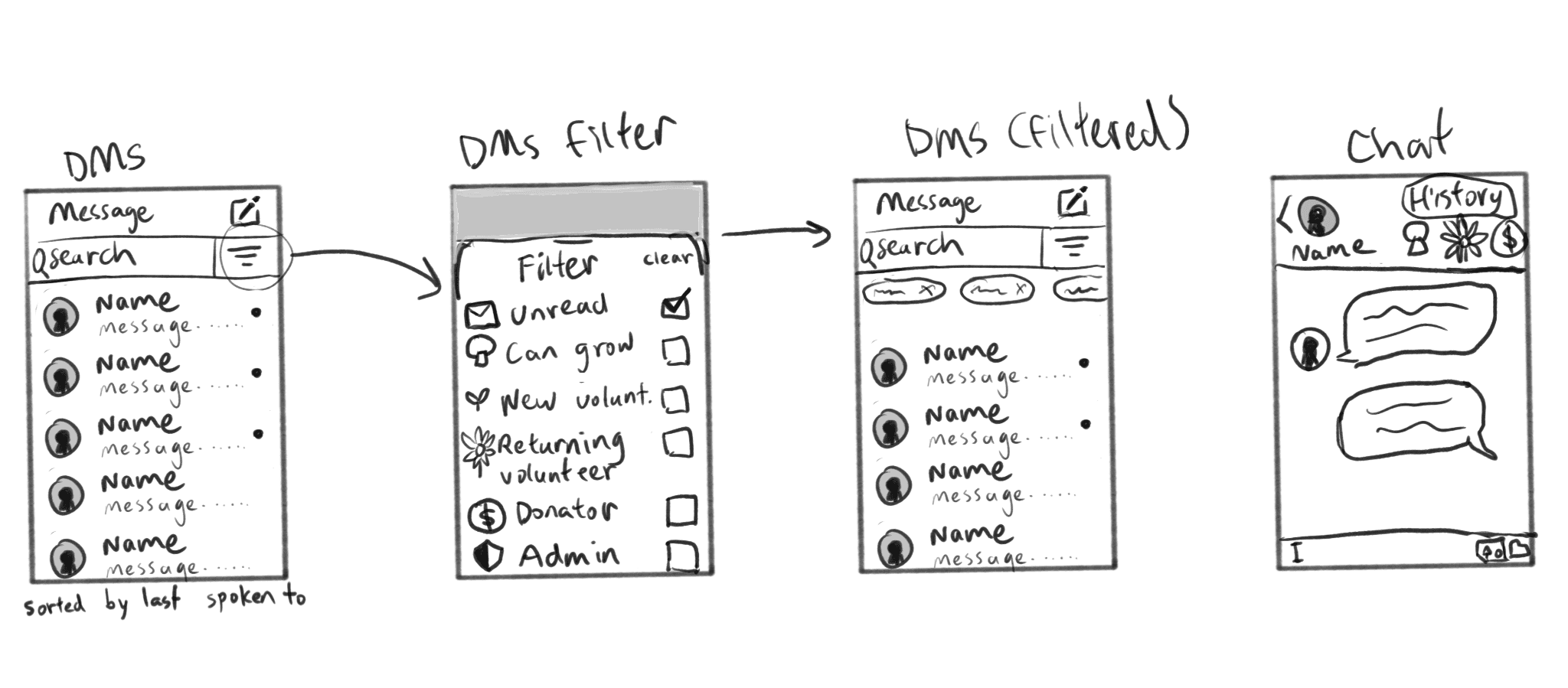
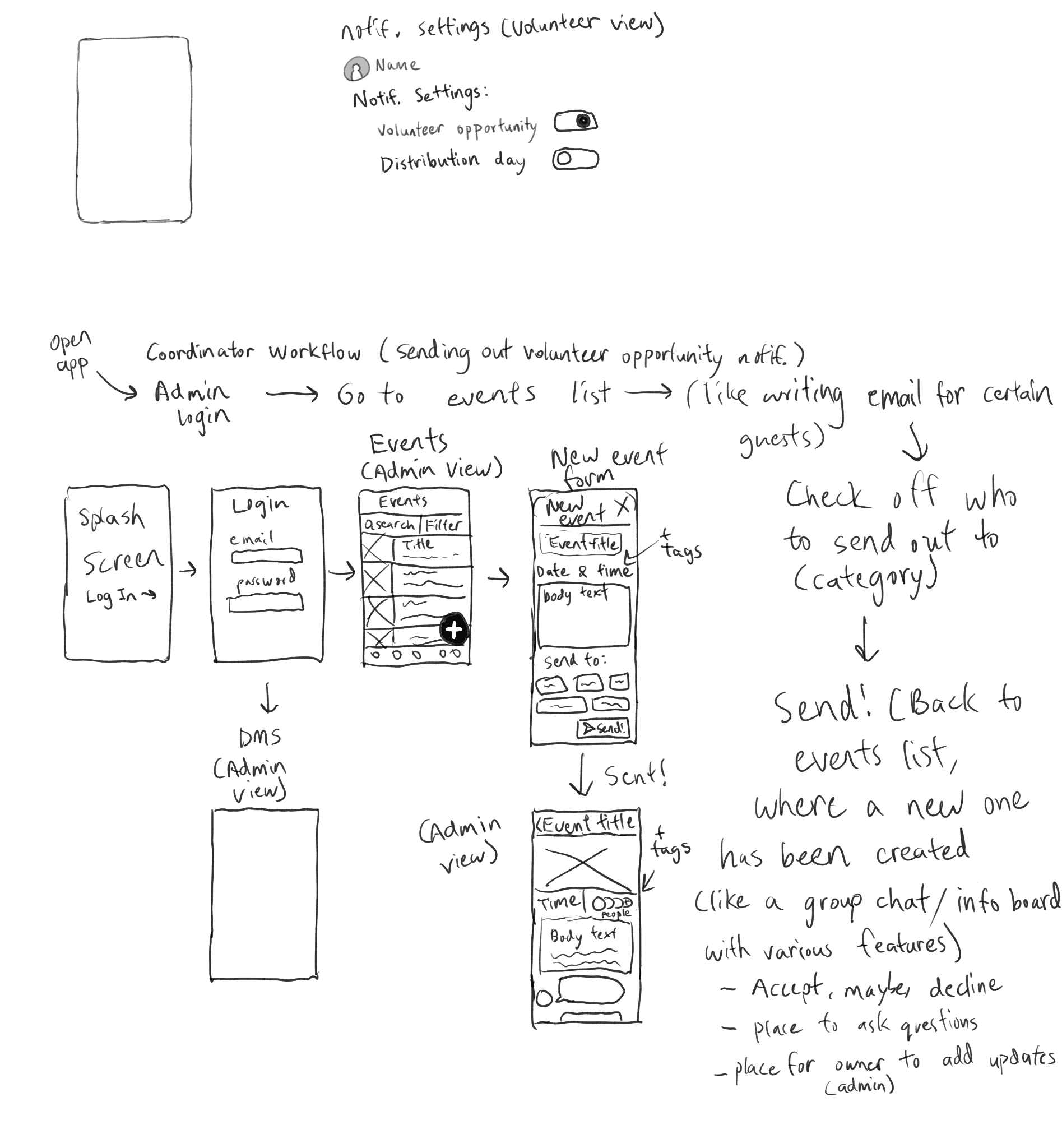
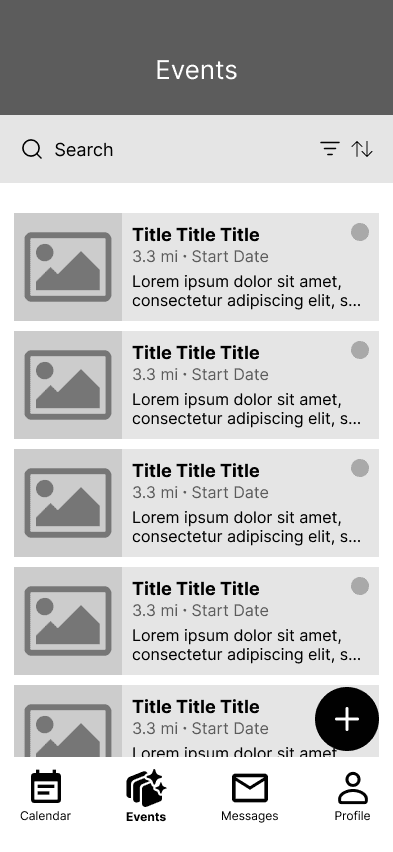
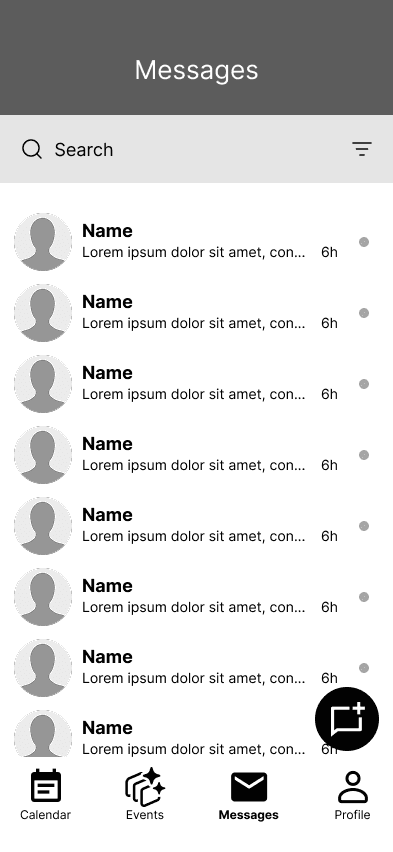
Wireframes: